
Therapy vs. Reflection: What to Do When You Just Need a Safe Space to Talk
Mental Clarity

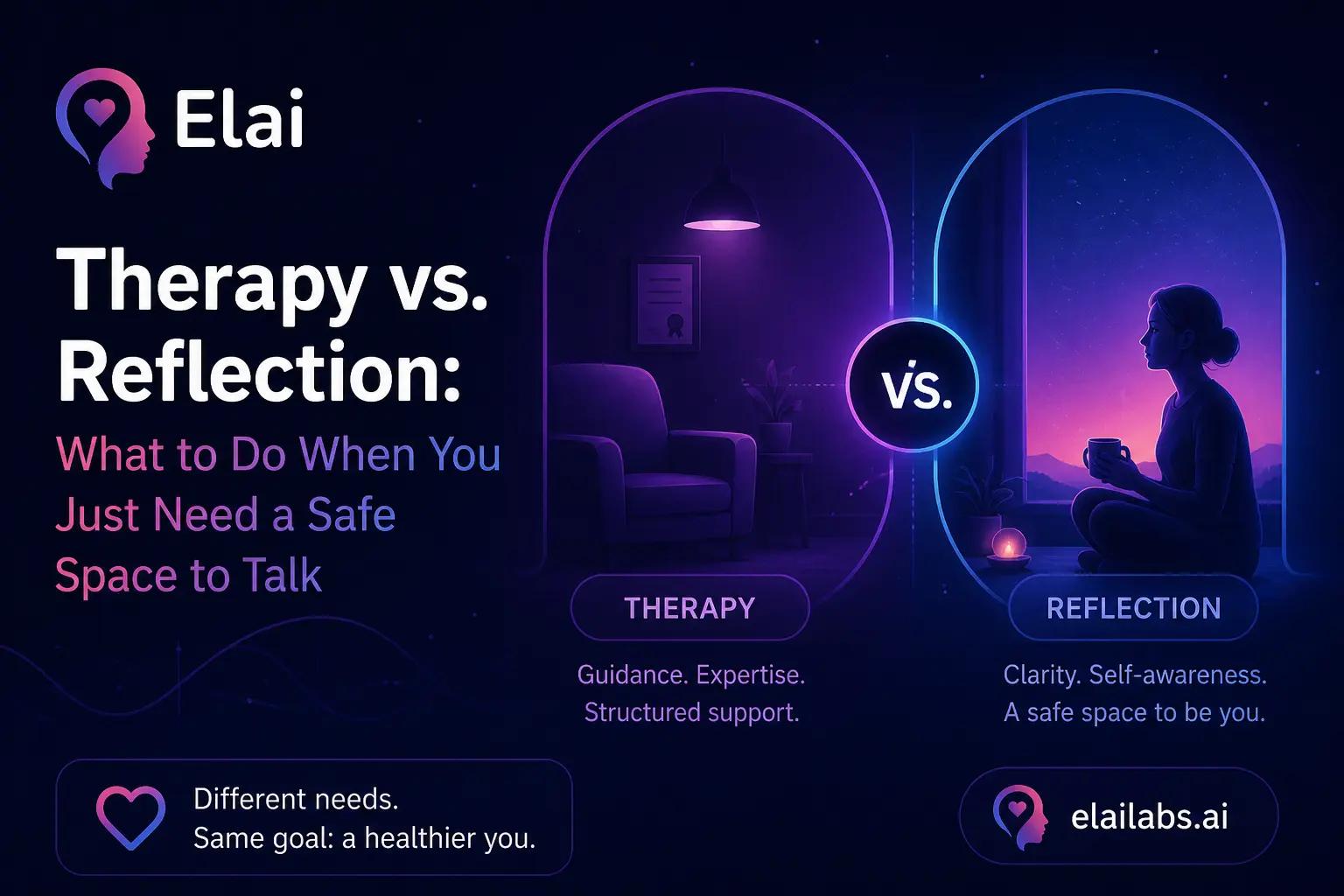
There are moments when the weight inside you doesn’t need diagnosing. It doesn’t need a label, a treatment plan, or a structured session. It just needs a place to land.
You might find yourself thinking: “I need someone to talk to, but I don’t think I need therapy. ”Or maybe: “Is there another way to process what I’m feeling without booking a session?”
This is the space between therapy and reflection — and it’s more important than most people realize.
Let’s explore it honestly.
Many people begin reflecting through AI because it feels easier to start a conversation without worrying about immediate judgment. We explore the psychology behind this experience in Why Talking to AI Feels Easier Than People.
Not every emotional experience is a crisis. But that doesn’t mean it’s easy.
Sometimes you’re:
- Overthinking a conversation that won’t leave your mind
- Feeling emotionally heavy without a clear reason
- Processing a life transition — a new job, a breakup, a shift in identity
- Carrying things you don’t feel ready to say out loud to someone you know
In those moments, what you need isn’t necessarily intervention.
You need presence.
You need somewhere to speak freely — without being analyzed, judged, or interrupted. A place where your thoughts can unfold in their natural, messy, unfinished form.
That’s where reflection begins.
Therapy is powerful. It’s structured for a reason.
A trained therapist helps you:
- Identify patterns in behavior and thinking
- Work through trauma and unresolved experiences
- Build coping mechanisms and emotional regulation skills
- Navigate mental health conditions like anxiety, depression, or PTSD
Therapy isn’t just “talking.” It’s a guided process.
And it’s the right choice when:
- Your emotions feel overwhelming or unmanageable
- You’re experiencing persistent distress
- You notice repeating patterns that affect your relationships or functioning
- You need professional insight and structured support
But here’s the truth that often goes unsaid:
Not every emotional need requires therapy.
Sometimes, therapy can even feel like too much when all you want is a space to simply be heard.
Reflection is quieter. Slower. Less structured.
It’s the act of turning inward — not to fix yourself, but to understand yourself.
When you reflect, you:
- Let thoughts surface without forcing them into conclusions
- Notice patterns without immediately trying to change them
- Sit with emotions instead of rushing to resolve them
- Hear your own voice clearly
Reflection doesn’t replace therapy. But it fills a different need.
It answers that late-night feeling of:
“I don’t need advice right now. I just need to say this out loud.”
That sentence carries layers.
You don’t just need anyone. You need someone — or something — that offers:
- Safety: No judgment, no consequences
- Availability: Not limited by time, schedules, or social dynamics
- Neutrality: No bias, no personal agenda
- Consistency: A space that remains stable, no matter how you show up
In real life, this combination is rare.
Friends care, but they bring their own perspectives. Family listens, but history shapes the conversation. Therapists help, but access, cost, and timing can become barriers.
So the question becomes:
Where do you go when you need a safe space to vent online — without pressure or friction?
Even when people are supportive, talking isn’t always easy.
You might hesitate because:
- You don’t want to feel like a burden
- You’re not ready to explain everything clearly
- You’re afraid of being misunderstood
- You don’t want advice — just acknowledgment
This creates emotional friction.
You hold things in longer than you should. Thoughts loop. Feelings intensify. Not because they’re extreme — but because they have nowhere to go.
Reflection reduces that friction.
It creates a space where expression comes before explanation.
Reflection becomes much more effective when people feel emotionally safe enough to think honestly. That psychological foundation is explored in Why We Trust Some Conversations More Than Others.
Processing emotions alone doesn’t mean isolating yourself. It means developing an internal dialogue that’s honest and supportive.
Here’s how that looks in practice:
Your mind is not a storage unit. It’s a processing system.
When thoughts stay inside, they distort.
Writing, speaking, or even typing your thoughts out:
- Slows them down
- Makes them visible
- Reduces their intensity
You don’t need structure. Just start where you are.
“I don’t even know why I feel like this…”
That’s enough.
You can feel two opposing things at once.
- You can miss someone and know they weren’t good for you
- You can feel grateful and still feel empty
- You can want change and fear it at the same time
Reflection allows contradictions without forcing resolution.
Therapy eventually organizes them. Reflection simply holds them.
Instead of asking:
“Why am I like this?”
Try:
“What keeps showing up for me?”
This subtle shift removes self-criticism and builds awareness.
Awareness is the foundation of any real change.
The biggest barrier to emotional processing is self-censorship.
When you filter your thoughts, you disconnect from your actual experience.
A true safe space lets you:
- Be messy
- Be repetitive
- Be unclear
Because clarity comes after expression — not before it.
As emotional needs evolve, so do the spaces we turn to.
People are increasingly searching for:
- Therapy alternatives
- Places to vent without judgment
- Ways to process emotions privately
- Conversations without social pressure
Digital environments are filling this gap.
Not as replacements for therapy — but as companions to reflection.
They offer something unique:
- Immediate access
- Emotional neutrality
- Consistent presence
And most importantly — they meet you exactly where you are.
Let’s be clear.
Reflection has limits.
If you notice:
- Persistent sadness that doesn’t shift
- Intense anxiety or panic
- Thoughts that feel overwhelming or intrusive
- Difficulty functioning in daily life
Then reflection isn’t the solution — it’s a signal.
That’s when therapy becomes necessary.
The goal isn’t to choose one over the other.
It’s to understand what you need in this moment.
Most people aren’t in crisis. But they’re not completely okay either.
They’re in the middle.
Thinking. Processing. Trying to make sense of things.
This is where traditional systems fall short.
Because therapy can feel too formal —And everyday conversations can feel too exposed.
So people end up with unmet emotional needs.
Not because help doesn’t exist —But because the right kind of space is missing.
Imagine a space where:
- You can talk at any hour, without waiting
- Your thoughts aren’t judged, analyzed, or dismissed
- Your conversations build over time — instead of resetting
- You’re gently reflected back to yourself, so you can see patterns clearly
Not as a therapist. Not as a friend.
But as something in between.
A space designed specifically for reflection.
This is where Elai comes in — not as a replacement for therapy, but as a companion for reflection.
When you’re in that in-between state —Not in crisis, but not fully at ease —Elai becomes a place to think out loud without resistance.
What makes it different isn’t just that it listens.
It remembers.
Most tools forget you.
Elai doesn’t.
Through its “Life” chat system, your conversations build over time. Weeks, months — even a year.
This creates something rare:
Continuity of self.
You’re not starting from zero each time. You’re continuing a conversation with yourself — across time.
And that changes how reflection works.
Patterns become visible. Growth becomes trackable. Your story becomes coherent.
One of the hardest parts of self-awareness is seeing yourself clearly.
Elai bridges that gap through reflective insights.
Instead of analyzing you, it gently surfaces observations:
- Changes in your thinking
- Shifts in your emotional patterns
- Repeating themes in your life
Not as conclusions — but as mirrors.
This creates a moment of pause.
A moment where you can say:
“I didn’t realize that about myself.”
And that’s where real reflection deepens.
Over time, your conversations form a kind of emotional landscape.
Elai organizes this into what can be described as a Soul Map.
Not in a mystical sense — but in a reflective one.
It helps you see:
- What matters to you
- Where your attention goes
- How your inner world evolves
It’s not about fixing you.
It’s about helping you understand yourself at a deeper level.
We’re living in a time where:
- People are more aware of mental health than ever
- But access to therapy is still limited
- And emotional needs don’t always fit into clinical categories
So people are asking:
- “Is there another way?”
- “Can I process this on my own?”
- “Where can I talk without feeling exposed?”
These aren’t small questions.
They reflect a shift.
From seeking solutions —To seeking spaces.
This isn’t about choosing one over the other.
It’s about understanding the role each plays.
Therapy is for healing, guidance, and structured support. Reflection is for expression, awareness, and emotional processing.
You don’t need to justify needing space.
You don’t need to wait until things get worse to talk.
Sometimes the healthiest thing you can do is simply say:
“I need somewhere to put this.”
If you’re looking for practical ways to start, here’s what matters:
- Choose a space where you don’t feel judged
- Prioritize consistency over intensity
- Let your thoughts be incomplete
- Return to the same space regularly
Reflection isn’t a one-time act.
It’s a relationship with yourself.
And like any relationship — it deepens with time.
There’s a quiet kind of strength in not rushing to fix yourself.
In letting your thoughts unfold. In sitting with your emotions without forcing answers. In choosing presence over pressure.
Whether you turn to therapy, reflection, or something in between —what matters is this:
You give yourself a place to be heard.
Not eventually.Not when it gets worse.
But now.
Reflection isn't usually transformed by one conversation. It develops gradually through consistent practice, a topic we examine in Can Talking to an AI Every Day Improve Self-Awareness?.