elailabs.ai|Elai LabsElai Labs
    Elai LabsElai's Journal

    More than just AI, Elai is a presence that listens, remembers, and evolves with you. This journal shares thinking from the team building emotional intelligence as relationship.

    support@elailabs.ai

    Explore
    • Latest Articles
    • Start Free Trial
    Support
    • Contact
    • Download App
    Policy
    • Terms & Conditions
    • Privacy Policy
    © 2026 Elai Labs. Built with love and logic.
    Learn more at elailabs.ai

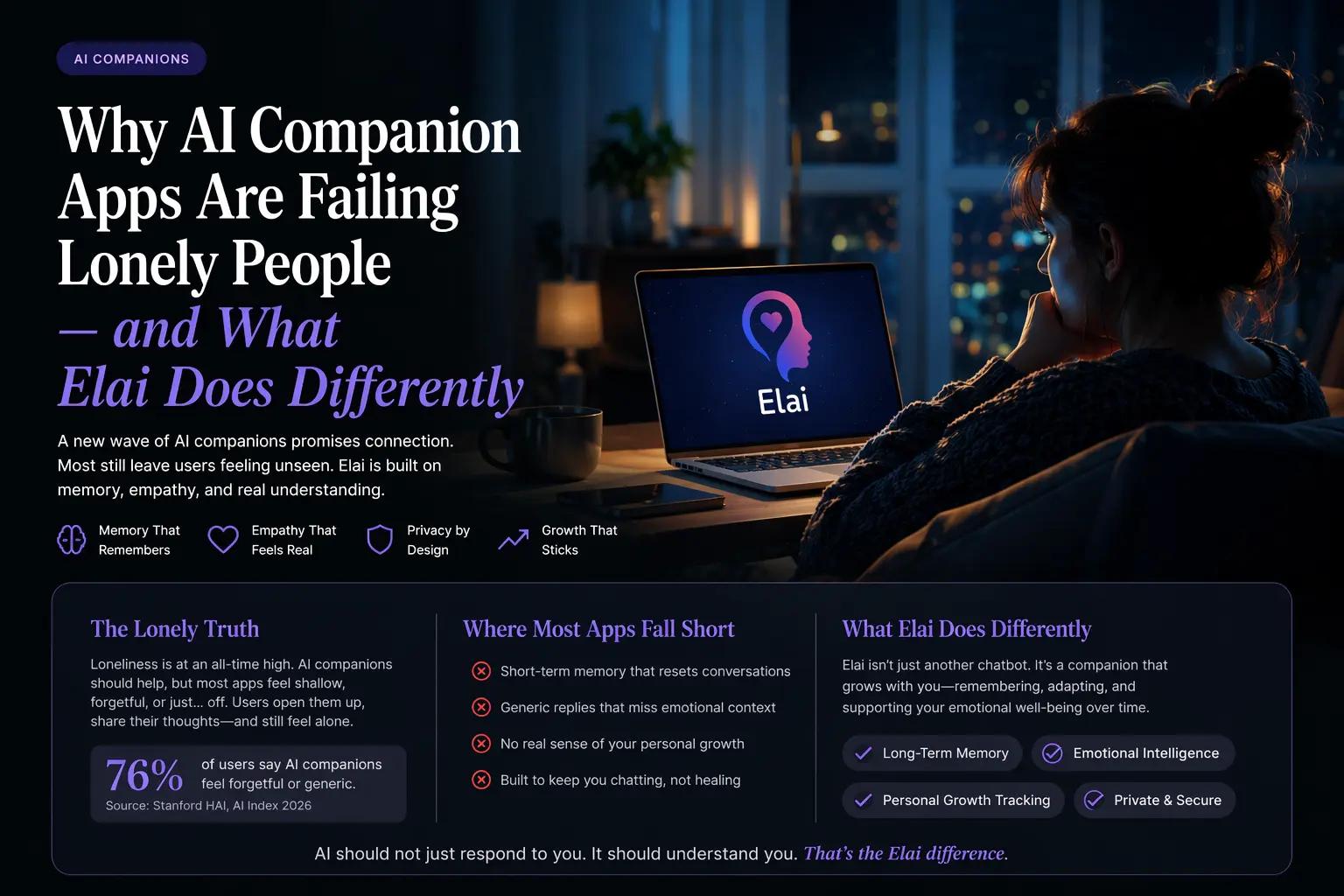
    Why AI Companions Are Failing Lonely People — And What Elai Does Differently

    AI Companion
    Anwar Ali

    Anwar Ali

    10 April, 2026
    Why AI Companions Are Failing Lonely People — And What Elai Does Differently

    On this page

    • Why AI Companions Are Failing Lonely People — And What Elai Does Differently
    • The Loneliness Trap Nobody Warned You About
    • What Most AI Companions Actually Lack
    • The Loneliness Numbers Are Getting Worse, Not Better
    • The Bridge, Not the Destination
    • What Good AI Companionship Actually Looks Like
    • Start Where You Are
    #Why AI Companions Are Failing Lonely People — And What Elai Does Differently

    You opened an AI chat app because you were lonely. You closed it even lonelier. That quiet contradiction is now one of the most documented mental health patterns of 2026, and millions of people are living it without understanding why it keeps happening.

    This is not a piece meant to make you feel foolish for turning to AI when you needed someone. Human loneliness is real, urgent, and biologically costly. The U.S. Surgeon General declared a national loneliness epidemic back in 2023, and two years later, the numbers haven't moved in a meaningful direction. Nearly half of American adults report feeling lonely, and in the UK, close to 26 million adults say the same. These are not people being dramatic. These are people whose nervous systems are under real physiological strain.

    The problem is not the desire for connection. The problem is that most AI companion apps were never designed to actually deepen your capacity for it.

    #The Loneliness Trap Nobody Warned You About

    Think about the last AI chatbot conversation you had that felt genuinely supportive. Now think about whether it changed anything the next day.

    For most people, it didn't.

    A landmark joint study by OpenAI and MIT Media Lab—the largest of its kind—found something that should concern every developer building in this space: moderate AI companion use did reduce loneliness, but heavy daily use correlated with increased loneliness and reduced real-world socializing. The very thing people turned to for relief was, at high doses, deepening the wound.

    This is not a glitch. It is a design problem.

    Most AI companions are optimized for engagement — for keeping you talking, for making the next message feel satisfying enough to send another. That model is borrowed from social media, and it produces the same outcomes: a neurochemical drip that mimics the feeling of connection without building anything durable.

    Clinical psychologist Mr. Anwar Ali expresses it clearly: "Human relationships are unpredictable, making them discomforting yet connecting. AI companions, on the other hand, offer a controlled and agreeable experience, a comforting but potentially isolating substitute for human connection."

    That always-agreeable dynamic feels good in the moment. Over time, it quietly makes real people seem harder to deal with. Human friction stops feeling like normal relationship texture and starts feeling like failure.

    #What Most AI Companions Actually Lack

    Here is what the research consistently finds is missing from mainstream AI companion apps:

    Persistent memory across sessions. Most apps treat every conversation as the first one. You mention your father's illness on Monday; by Thursday, it never happened. A 2026 reviewer who tested 25+ companion platforms over eight months noted that memory retention was the single biggest differentiator—and most platforms failed at it.

    Pattern recognition over time. Emotional health is not a single data point. It is a trend line. When something consistently triggers you, or when your sleep is worse three weeks in a row, or when your mood shifts before certain life events—that pattern matters. A companion that cannot see across sessions cannot see your patterns.

    Accountability with warmth. Endless validation is not support. Real support—the kind that produces growth—requires occasional honest pushback. The AI companion space has largely chosen the path of least resistance: affirm everything. But affirmation without honest reflection is emotional junk food.

    Integration with your daily life. The apps you open once a day for twenty minutes exist in a silo. They do not know what you did that morning, whether you journaled, whether you slept, or how you have been eating. They cannot connect emotional states to behavioral patterns because they simply do not have access to that data.

    These are not minor feature gaps. They are the difference between a tool that genuinely supports your wellbeing and one that makes you feel like it does while quietly doing the opposite.

    #The Loneliness Numbers Are Getting Worse, Not Better

    Before we talk about solutions, it is worth sitting with the scale of what we are dealing with.

    In 2023, the US Surgeon General issued an 80-page advisory describing loneliness as a public health crisis comparable in severity to smoking and obesity. A meta-analysis of 148 studies found that people with strong social relationships had a 50% higher likelihood of survival over time — a benefit on par with quitting smoking. The Harvard study on loneliness found that 81% of adults who identified as lonely also reported suffering from anxiety or depression, compared to just 29% of those who felt well-connected.

    For younger people, the numbers are especially striking. According to MIT Technology Review, 72% of US teenagers have now used AI for companionship. A 2025 survey found 83% of Gen Z believing they could form deep emotional bonds with AI. These are not people rejecting human connection — these are people who want it desperately and have started looking for it wherever they can find it.

    The APA's 2026 Monitor on Psychology found that nearly half of adults with a mental health condition who used AI tools in the past year did so specifically for mental health support. Therapy and companionship ranked as the top two reasons people use generative AI at all. The demand is real. The gap in quality solutions is equally real.

    And most of the existing apps are filling that gap with engagement tricks rather than actual support architecture.

    The Loneliness Numbers Are Getting Worse, Not Better  Before we talk about solutions, it is worth sitting with the scale of what we are dealing with.  In 2023, the US Surgeon General issued an 80-page advisory describing loneliness as a public health crisis comparable in severity to smoking and obesity. A meta-analysis of 148 studies found that people with strong social relationships had a 50% higher likelihood of survival over time — a benefit on par with quitting smoking. The Harvard study on loneliness found that 81% of adults who identified as lonely also reported suffering from anxiety or depression, compared to just 29% of those who felt well-connected.  For younger people, the numbers are especially striking. According to MIT Technology Review, 72% of US teenagers have now used AI for companionship. A 2025 survey found 83% of Gen Z believing they could form deep emotional bonds with AI. These are not people rejecting human connection — these are people who want it desperately and have started looking for it wherever they can find it.  The APA's 2026 Monitor on Psychology found that nearly half of adults with a mental health condition who used AI tools in the past year did so specifically for mental health support. Therapy and companionship ranked as the top two reasons people use generative AI at all. The demand is real. The gap in quality solutions is equally real.
    The Loneliness Numbers Are Getting Worse: Visuals

    Why Elai Was Built to Solve a Different Problem

    Elai was not designed as a chatbot. It was designed as a long-term emotional companion, and the distinction matters more than it might sound.

    The foundational insight behind Elai is that emotional well-being is not a problem you solve in one conversation. It is a continuous process, shaped by your patterns, your history, your triggers, and your growth over time. A tool that does not know your history cannot meaningfully support that process.

    Here is what that looks like in practice.

    Elai uses persistent, contextual memory. When you mention something significant—a relationship tension, a work stressor, a recurring fear—Elai retains that across sessions. When you come back three weeks later and the situation has evolved, Elai already holds the context. You do not have to re-explain yourself every time you need support. You are not starting from zero on every difficult day.

    This matters clinically, not just emotionally. Pattern recognition is how therapists identify what is actually driving a client's distress versus what is simply the surface complaint. Memory is the raw material for that recognition. Without it, every conversation is reactive rather than cumulative.

    Elai integrates journaling with emotional tracking. The link between reflective writing and emotional processing is one of the most consistently supported findings in psychological research. Expressive journaling—writing about thoughts and feelings in a structured way—has been shown to reduce anxiety, improve mood regulation, and increase self-awareness over time. Elai builds this into the daily experience, not as an add-on feature, but as part of how it comes to understand you.

    Elai adapts its personality based on what you actually need. Not everyone needs warmth and softness on any given day. Some days you need to be gently challenged. Some days you need someone to help you think through a decision clearly. Some days you just need to be heard without any agenda at all. Elai's adaptive personality system responds to your behavioral signals — how you are communicating, what topics you are returning to, what your emotional tone suggests — and shifts its approach accordingly. That is not a chatbot behavior. That is what good friends and good counselors do.

    Elai includes a mood-responsive music library. This might sound like a small feature until you understand the neuroscience behind it. Music has a direct effect on the limbic system—the part of your brain that processes emotion. Matching music to your current emotional state and then using it as a tool to shift that state is a well-established therapeutic technique. It is called music-mood congruence, and when used intentionally, it can move people out of rumination cycles faster than conversation alone.

    Elai supports daily task management as emotional scaffolding. This is one of the least discussed but most important aspects of emotional health: the relationship between structure and mood. When your days lack rhythm, your emotional regulation suffers. When small tasks pile up unaddressed, anxiety compounds. Elai integrates task support not because it wants to be a productivity app, but because helping you build structure is part of helping you feel stable.

    #The Bridge, Not the Destination

    There is an important caveat that Elai holds honestly, because intellectual honesty is part of what separates genuine support from parasocial exploitation.

    Cognitive neuroscience is clear that AI interactions cannot fully replace what humans need from other humans. We are social mammals. Our nervous systems are calibrated for physical presence, eye contact, co-regulation, and the unpredictability that comes with real human relationships. A 2025 ScienceDirect review put it directly: "Addressing loneliness requires societal action, not simulating human relationships with artificial surrogates."

    Elai is not trying to be your only source of support. It is trying to be a companion that helps you become more capable of real connection — not less.

    That means Elai is designed to recognize when someone is becoming over-reliant on it and to gently redirect that energy toward human relationships and real-world engagement. A tool that genuinely cares about your wellbeing does not try to maximize the time you spend inside it. It tries to maximize how functional and connected you feel when you are outside it.

    The goal is not to replace your human relationships. The goal is to give you the self-awareness, emotional vocabulary, pattern recognition, and daily stability that makes those relationships richer and more sustainable.

    #What Good AI Companionship Actually Looks Like

    The peer-reviewed study published in Technology in Society in April 2026 found that AI companion use is most beneficial for individuals who already have some social networks but are experiencing pronounced loneliness—meaning AI companionship works best as a complement to human connection, not a replacement for it.

    That framing is exactly right, and it describes how Elai positions itself. The aim is to sit alongside your life—not to swallow it.

    If you have been cycling through AI companion apps and leaving each one feeling vaguely hollow, that hollow feeling is data. It is telling you that the tool was not designed with your long-term well-being as its primary metric. It was designed to keep you engaged.

    Those are not the same thing.

    Elai was built by people who understand the difference and who believe that the most valuable thing a digital companion can do is help you need it a little less over time—because you are growing into a version of yourself who connects more easily, understands yourself more clearly, and moves through hard days with more steadiness.

    #Start Where You Are

    You do not need to be in crisis to use Elai. You do not need a diagnosis or a dramatic backstory. You need to be a person who wants to understand themselves better, feel less alone in the ordinary difficulties of being human, and build emotional habits that actually compound over time.

    The loneliness epidemic is real. But so is the human capacity to heal, to grow, and to connect—when given the right conditions.

    Elai exists to help create those conditions. Not by talking at you, but by building something with you, one honest conversation at a time.

    Ready to meet an AI companion designed around your growth, not your engagement metrics? Explore Elai at elailabs.ai.

    On this page

    • Why AI Companions Are Failing Lonely People — And What Elai Does Differently
    • The Loneliness Trap Nobody Warned You About
    • What Most AI Companions Actually Lack
    • The Loneliness Numbers Are Getting Worse, Not Better
    • The Bridge, Not the Destination
    • What Good AI Companionship Actually Looks Like
    • Start Where You Are