

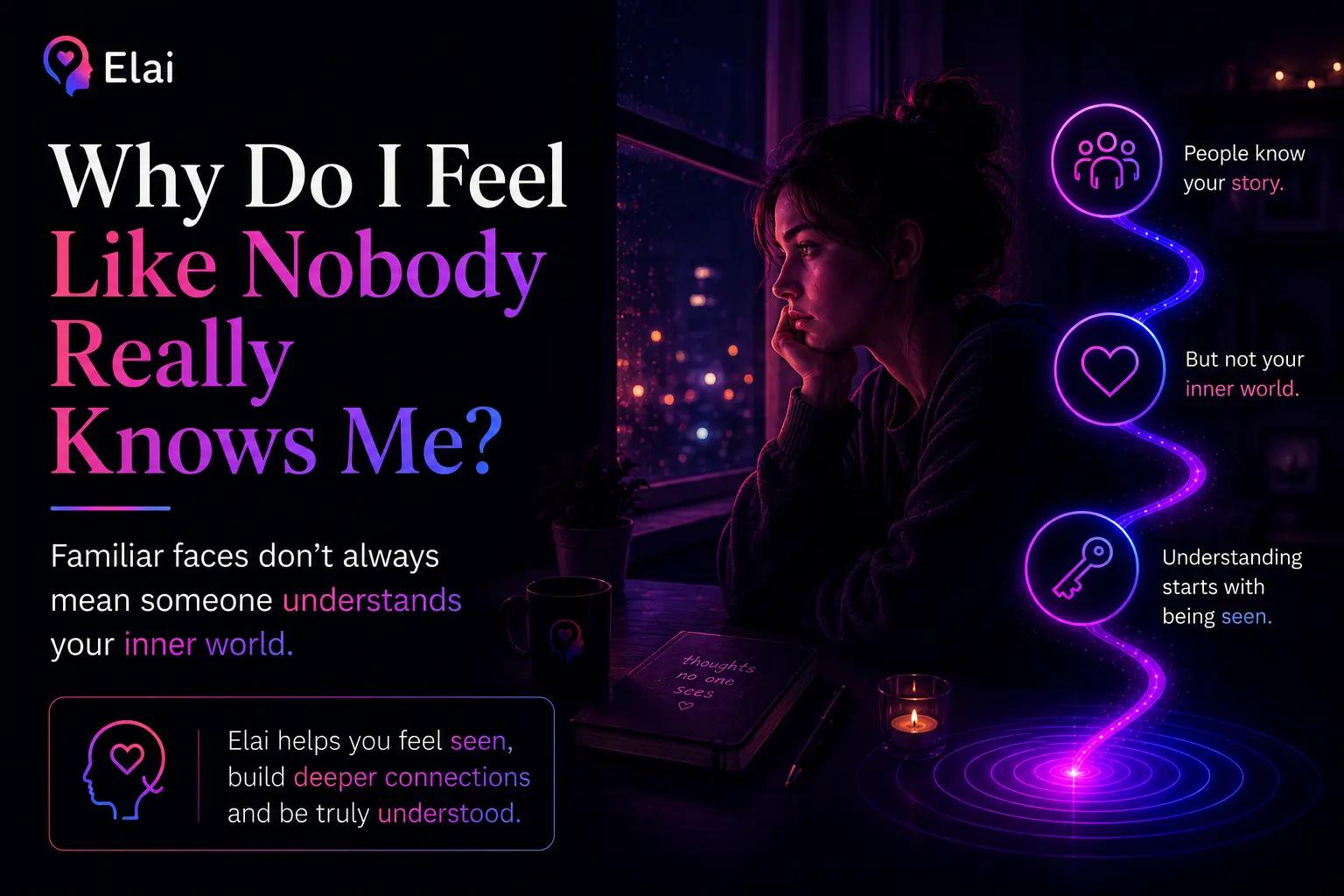
You can spend years around the same people and still carry the feeling that nobody truly knows who you are.
Your friends know your favourite foods, the stories you've told a hundred times and the way you usually react to certain situations. Your family knows your habits, your routines and many of the experiences that shaped your life. The people you work with know your strengths, your personality and the role you naturally play in a team. From the outside, it would seem impossible to believe that someone surrounded by familiar faces could still feel deeply misunderstood.
Yet this feeling is remarkably common. It usually appears during quiet moments rather than dramatic ones. You finish dinner with people you genuinely care about, drive home and suddenly realise that nobody there knows what has really been on your mind for weeks. A friend asks how you're doing, and you answer honestly enough to keep the conversation going, but not honestly enough to describe what you've actually been carrying. Nothing about the conversation felt wrong, yet something important never became part of it.
Many people assume this means they need better friends or deeper conversations. Sometimes that's true, but often the explanation is much simpler. Being known isn't measured by how much information other people have about your life. Someone can know your birthday, your career, your hobbies, your favourite music and even your biggest achievements without ever knowing what your inner world actually feels like.
That difference is easy to overlook because we often confuse familiarity with understanding. The longer people have known us, the more we assume they understand us completely. In reality, familiarity mostly tells people what we usually do. Understanding is something very different. It requires seeing the thoughts, doubts and emotions that rarely become visible during everyday conversation.
Think about the conversations you've had over the past week. Most probably revolved around work, family, plans, news, daily routines or practical problems that needed solving. These conversations matter because they keep relationships alive, but they also follow familiar patterns. Everyone shares updates, responds politely and gradually moves from one topic to another until it's time to leave.
Very little of this requires revealing what has genuinely been happening inside us. Someone can spend an entire evening talking without ever mentioning the thought that has occupied them every day for the past month. Another person can laugh throughout dinner while quietly questioning a major life decision they haven't told anyone about. From the outside, both conversations appear warm and successful. From the inside, they can leave someone feeling unexpectedly invisible.
That is why loneliness sometimes exists in the middle of strong relationships. It isn't always caused by being physically alone. Sometimes it comes from repeatedly leaving conversations with the feeling that people interacted with your daily life rather than your inner experience.
Most people don't deliberately hide who they are. Instead, they become skilled at offering versions of themselves that are easy to understand. We talk about work because it's simple to explain. We describe what happened rather than how it affected us. We tell stories instead of uncertainties. We discuss decisions after we've already made them rather than while we're still struggling to make them.
These habits make everyday conversation smoother, but they also create an unexpected consequence. Over time, the version of ourselves that other people know becomes increasingly organised and predictable, while the version we experience privately remains far more complicated.
Eventually, people begin responding to the person they've learned to recognise. They describe you as calm, confident, funny or dependable because that's the version they've consistently seen. Their understanding isn't necessarily wrong. It's simply incomplete. Meanwhile, the parts of yourself that feel uncertain, conflicted, hopeful or afraid remain largely invisible because they rarely entered the conversation in the first place.
Many of us quietly hope that the people closest to us will eventually understand us without us having to explain ourselves. We believe that enough years together should somehow remove the need for difficult conversations. If someone truly knows us, surely they should already understand what we're feeling.
Real relationships rarely work that way.
People can only understand the parts of us that have had the opportunity to become visible. They can notice changes in our mood, recognise familiar behaviours and remember important events, but they cannot automatically see thoughts we've never expressed or emotions we've carefully kept to ourselves. Even the people who love us most are responding to what we have allowed them to experience.
Perhaps that is why the feeling of being unknown can exist even inside loving relationships. It isn't always that people failed to understand us. Sometimes they never had the chance to know the parts of ourselves we assumed they would somehow discover on their own.
Think about how relationships naturally develop over time. The more often people see the same behaviours, the more confidently they begin believing that's simply who you are. If you're usually the calm one, they expect calmness. If you're known for solving problems, they come to you whenever something goes wrong. If you're the funny person in the group, people naturally expect you to lighten the mood.
None of these expectations are intentionally harmful. They're built from real experiences. The problem is that they only reflect the parts of yourself that have appeared often enough for other people to recognise. The quieter parts of your personality rarely receive the same attention because they don't appear often enough to become part of other people's picture of you.
Over time, something subtle begins to happen. Instead of introducing new parts of yourself, you continue confirming the version people already expect. Not because they're forcing you to, but because it's easier than explaining that you're changing. Eventually you realise that everyone around you knows a consistent version of you, while the person you experience privately feels much more complicated than the one everyone else seems to recognise.
One reason people don't truly know us is that we usually wait until we've already understood ourselves before talking about something important.
Think about the conversations you've had after making a major decision. It's often easy to explain why you changed careers, ended a relationship or moved somewhere new because you've already organised the experience in your own mind. The difficult part wasn't explaining the decision afterwards. The difficult part was talking while you were still uncertain.
Most people keep those unfinished thoughts private. While they're confused, questioning themselves or trying to understand their emotions, they say very little. Only once everything makes sense do they begin telling the story.
The result is that other people become familiar with the conclusions of our lives but rarely witness the process that led there. They know what happened, but not what it felt like while it was happening. They know the final chapter but never saw the pages that came before it.
Perhaps this is why people can be surprised by decisions that took us months to make. They think everything changed suddenly because they only saw the ending. They never saw the long internal conversation that had been unfolding long before a single word was spoken aloud.
Another reason people don't know us as deeply as we'd like is that we spend much of our lives trying not to become a burden.
When someone asks how we're doing, we quickly judge whether this feels like the right moment to answer honestly. We notice whether they're busy, tired or distracted. We wonder whether sharing something personal will make the conversation uncomfortable. Sometimes we decide that what we're feeling can wait until another day.
The strange part is that this happens even in close relationships. We tell ourselves we'll explain it later, once we've figured it out properly or once the timing feels better. Days become weeks, weeks become months and eventually the moment quietly disappears. Life continues as though nothing important happened.
Meanwhile, the people around us believe they know what's been going on because nothing outwardly suggested otherwise.
The distance between feeling understood and feeling unknown often grows through hundreds of moments exactly like these. Not because anyone intended to create distance, but because important thoughts kept being postponed until they eventually stopped being shared altogether.
If someone asked your closest friend to describe you, they could probably tell them a great deal. They would know where you work, what you enjoy doing, what makes you laugh and perhaps even what you've been through in life.
Yet imagine someone asking a different question.
"What has been worrying them lately?"
"What do they secretly doubt about themselves?"
"What thought has been returning to them over and over again this month?"
Those questions are much harder to answer because they belong to a different kind of knowing. They aren't about information. They're about someone's inner experience.
Many relationships become rich in shared history while remaining surprisingly poor in shared inner worlds. Years pass together, memories accumulate, routines become familiar, yet the thoughts that occupy our minds every day remain largely invisible because ordinary conversation rarely asks for them.
We often believe that enough time automatically creates understanding. It certainly creates familiarity, but understanding grows differently. It develops through moments where someone is willing to reveal uncertainty before certainty, confusion before conclusions and emotions before they've been neatly explained.
Those moments don't happen every day. In fact, they are surprisingly rare. Everyday life encourages efficiency. We discuss schedules, responsibilities and practical concerns far more often than the questions quietly shaping our inner lives.
That is why people can spend decades together and still occasionally feel unknown. Time creates history. Understanding requires something else entirely.
Why Being Truly Known Feels So Rare
One of the quietest mistakes we make in relationships is believing that the people closest to us automatically understand us. It feels like a reasonable assumption. They've known us for years. They've seen us at our best and our worst. They've celebrated important milestones and supported us through difficult times. If anyone should know us completely, surely it would be them.
Yet closeness doesn't automatically create understanding. It creates opportunity.
People understand us through what they experience, not through what we silently carry. They notice what we choose to express, the emotions we allow ourselves to show and the stories we decide to tell. Everything else remains hidden, no matter how much they care about us. They cannot understand thoughts they've never heard, fears we've never described or questions we've never admitted we're asking ourselves.
That isn't a failure of love. It's simply one of the limits of human relationships. Even the people who care about us most cannot read experiences that have never become visible.
Many people don't hide themselves because they're afraid of honesty. They hide because they're waiting for the right moment.
They tell themselves they'll bring it up when life becomes less busy. They'll explain it after they've figured it out properly. They'll talk about it once they're certain they're making sense. Until then, they keep carrying the thought alone.
The problem is that conversations rarely stop and invite those moments naturally. Life continues moving. New topics replace old ones. New responsibilities appear. Every postponed conversation quietly becomes easier to postpone again.
Months later, someone close to us says, "I had no idea you were feeling that way."
The sentence often sounds surprising, but it shouldn't. They couldn't know what never became part of the relationship. We assumed they would somehow notice what we had spent months carefully keeping inside.
Sometimes feeling unknown isn't the result of being misunderstood. It's the result of believing that the people who love us should somehow discover what we've never found the words to share.
When people misunderstand us, our first instinct is often to believe they've created a false picture of who we are. In many cases, that's not actually what happened.
The version they know is real.
It simply isn't complete.
The dependable person is genuinely dependable. The confident person is genuinely confident. The cheerful person is genuinely cheerful. Those qualities aren't performances. They are authentic parts of someone's personality. The problem begins when those visible qualities become the entire story.
Every person contains contradictions that rarely appear at the same time. Someone can be confident in public and uncertain in private. They can enjoy being around people while still feeling lonely. They can appear calm while carrying thoughts they have never spoken aloud. None of these realities cancel each other out. They simply reveal that human beings are always more complex than the single version other people usually experience.
Perhaps one of the reasons this feeling is so painful is that we imagine being understood as something that should happen automatically in close relationships. We believe enough years together should eventually remove the need to explain ourselves.
Real understanding rarely arrives that way.
It grows through dozens of ordinary moments where someone chooses to reveal something they could easily have kept private. A worry before it's solved. A doubt before it's answered. A feeling before it's neatly organised into a story. Those moments slowly build an understanding that facts and shared history alone can never create.
Being known isn't a single conversation. It's a gradual process of allowing another person to see parts of your inner world they couldn't possibly discover on their own.
None of this means every thought needs to be shared or that every relationship must become deeply personal. Privacy is healthy. Boundaries matter. Some experiences belong to us alone.
The difference lies in whether silence feels like a choice or a habit.
When every important thought stays inside because it feels easier than explaining it, the distance between us and other people naturally grows. Not because anyone stopped caring, but because relationships can only connect with what is allowed to exist between them.
Sometimes one honest conversation reveals more about who we are than years of ordinary small talk.
If you've ever felt that nobody really knows you, it doesn't necessarily mean you're surrounded by the wrong people. Nor does it automatically mean you've spent your life pretending to be someone else.
It may simply mean that your deepest thoughts have remained where they first appeared—inside your own mind.
People can't understand experiences they've never been invited into. They can't recognise emotions they've never had the opportunity to witness. Even the people who love us most only know the parts of ourselves that life has allowed them to see.
Perhaps that's why feeling understood is so rare. It isn't created by spending more time together. It happens when someone is trusted with thoughts that previously existed only in silence.
Maybe the question isn't whether nobody really knows you.
Maybe the better question is whether anyone has truly been given the chance.