

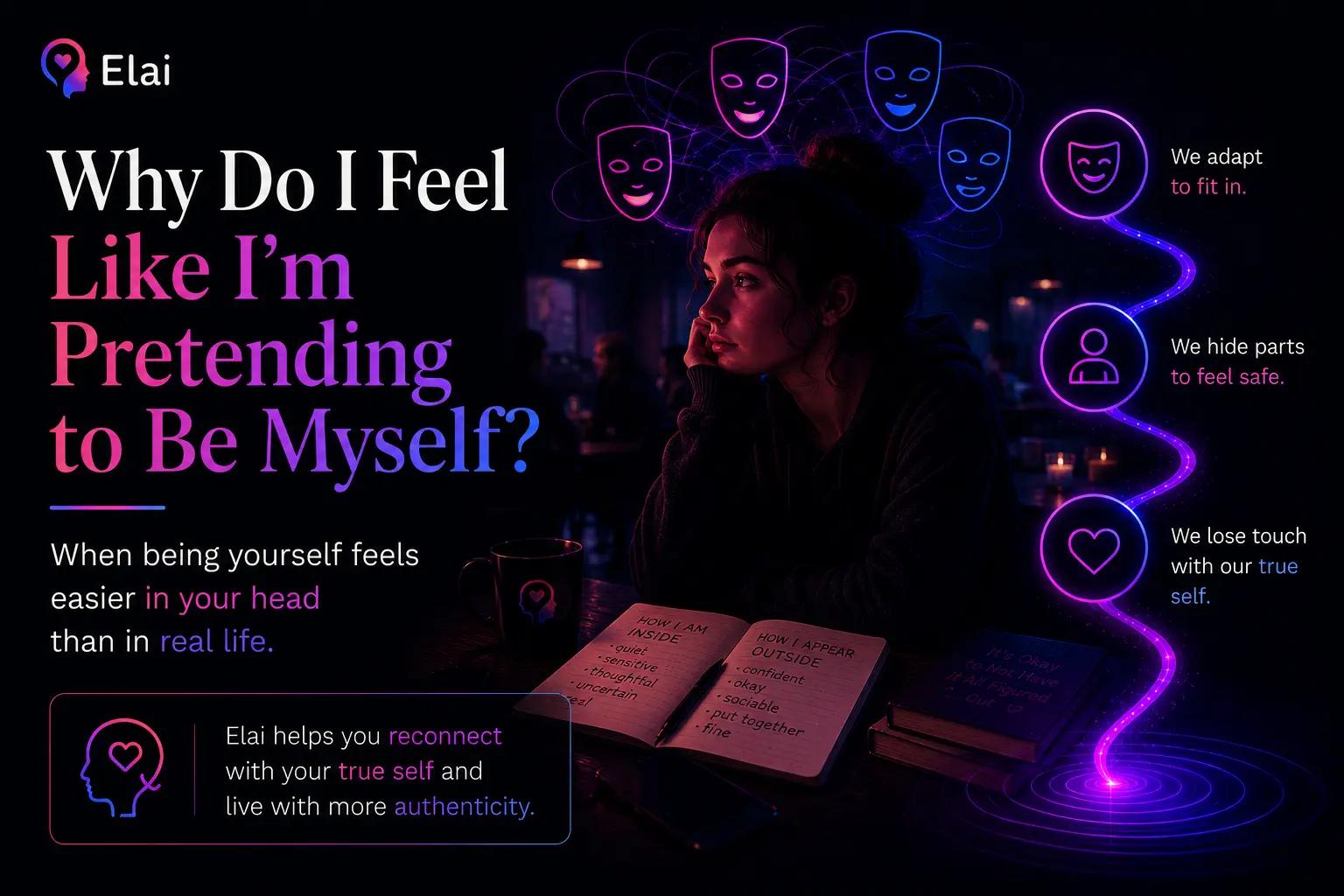
Have you ever reached the end of a normal day and felt strangely disconnected from the person who lived it? You spoke to colleagues, replied to messages, laughed when everyone else laughed and carried out your responsibilities exactly as expected. Nothing unusual happened. Nobody questioned your behaviour, and there was no obvious reason to feel uncomfortable. Yet later that evening, perhaps while driving home or lying in bed, a quiet thought appeared that was difficult to ignore. Why did none of that feel completely like me?
The feeling is surprisingly difficult to describe because it doesn't resemble the way people usually talk about identity. It isn't the same as lacking confidence, and it isn't simply being shy or introverted. Many people who experience it function perfectly well in everyday life. They perform well at work, maintain friendships, care for their families and appear completely comfortable in social situations. If someone asked whether they were happy or whether everything was going well, they would probably answer yes. Yet beneath those ordinary interactions is a persistent sense that they spend much of their time becoming the version of themselves that each situation seems to require.
Sometimes the feeling appears in the middle of a conversation. You hear yourself agreeing with opinions that you haven't fully thought about simply because it keeps the conversation moving. Other times you laugh at jokes that didn't really feel funny, avoid mentioning something that genuinely mattered to you or speak with a confidence that disappears the moment you are alone. None of these moments feel dishonest enough to call lying, yet together they create an uncomfortable impression that your personality has become something you perform rather than something you naturally experience.
Many people assume this means they're being fake. That conclusion is understandable because the experience certainly feels artificial. If you're constantly adjusting yourself depending on who you're with, it seems reasonable to wonder whether there is a genuine version hiding underneath. Yet this explanation creates another problem. If you were truly pretending, then who exactly would you be pretending to be? After all, the personality you're performing didn't come from nowhere. It developed gradually through years of relationships, responsibilities, expectations and experiences that quietly shaped the way you learned to move through the world.
Perhaps that is why this feeling often appears during periods of reflection rather than during the conversation itself. While you're talking, you're busy responding, listening and keeping the interaction moving. It is only afterwards, when everything becomes quiet again, that you begin comparing how you behaved with how you actually felt. That comparison creates a gap between your outward behaviour and your private experience, and it is inside that gap that the question begins to grow. Was that really me, or was I simply becoming the person the situation seemed to expect?
Nobody sits down as a child and decides to create different personalities for different situations. Instead, we slowly learn which parts of ourselves are welcomed, which parts receive praise and which parts seem to create problems. A child who is described as "the quiet one" may begin speaking less without consciously choosing to. Another who is constantly praised for being responsible may gradually become the dependable person everyone turns to, even when they feel overwhelmed themselves. These changes happen so gradually that they rarely feel like choices. They simply become habits of being.
As we grow older, those habits become increasingly sophisticated. School teaches us one version of ourselves. Work encourages another. Friendships reveal another, while family relationships often preserve older versions that have existed for years. Each environment rewards different behaviours, and without realising it we become remarkably skilled at recognising what each situation expects from us. The process is so natural that most people never question it until they begin wondering why they feel different depending on who happens to be standing in front of them.
Think about how differently you speak to a close friend compared with someone you've just met. The words change, your tone changes, the stories you tell change and even your sense of humour often changes. None of this is unusual. Human beings naturally adjust themselves according to the emotional safety of the relationship they're in. Around people who make us feel accepted, we often become more playful, curious or emotionally honest. Around people whose opinions matter deeply to us, we may become more careful, more polite or more reserved.
These differences are not evidence that one version is real while the others are fake. They simply show that personality is more flexible than we often imagine. The difficulty begins when we mistake flexibility for inauthenticity. If every important relationship asks for something slightly different, it becomes surprisingly easy to lose sight of what feels natural when nobody else is influencing the situation.
Adapting to other people is part of everyday life, but adaptation has a limit. If every conversation requires careful monitoring of your words, emotions and reactions, the effort gradually becomes tiring. You begin leaving ordinary interactions feeling strangely drained, not because the conversations were unpleasant, but because maintaining the version of yourself that seemed most appropriate required constant attention.
That exhaustion often creates the illusion that you have been pretending all day. In reality, the problem may not be that you became someone else. The problem may be that you spent so much energy adjusting yourself to different expectations that you never had the opportunity to notice what your own thoughts, preferences and emotions were trying to say in the first place.
One reason this experience is so confusing is that it rarely happens while the interaction is taking place. During conversations, your attention is focused on responding, listening, interpreting facial expressions and deciding what to say next. There is very little mental space left for observing yourself. Reflection usually begins afterwards, when the conversation is over and your attention finally returns inward.
That delay explains why so many people describe the feeling as arriving unexpectedly. They don't notice themselves adapting in the moment. They notice it afterwards, when they replay the interaction and realise how little of what they truly thought or felt ever became part of the conversation. The question that follows isn't simply whether they behaved appropriately. It's whether they were ever fully present as themselves at all.
One of the first things many people notice is that this feeling almost disappears when they're alone. There is no audience to impress, no conversation to keep alive and no expectations to meet. You don't have to decide whether a joke is appropriate, whether your opinion will be accepted or whether you're saying too much. You simply exist without constantly adjusting yourself to another person's reactions. That contrast can be surprisingly revealing because it raises an uncomfortable question. If being alone feels more natural than being around other people, what changes the moment someone else enters the room?
The answer isn't necessarily that other people force us to become someone we're not. More often, their presence changes what our attention focuses on. Instead of paying attention to our own thoughts, we begin paying attention to how those thoughts will be received. Before speaking, we quietly edit ourselves. We soften certain opinions, avoid certain stories, hide uncertainty, exaggerate confidence or replace honesty with something that feels safer. Most of these decisions happen so quickly that they never feel like decisions at all. They simply become the normal way we communicate.
That is why solitude can feel strangely peaceful even for people who enjoy being around others. It isn't always the absence of conversation they enjoy. It's the absence of constant self-monitoring. Without realising it, many people spend so much of their social life observing themselves that they rarely experience what it feels like to simply be themselves.
Think about how naturally your behaviour changes when you realise someone is watching you. You might walk differently, choose your words more carefully or become unusually aware of simple things like where you're looking or what your hands are doing. None of these changes happen because you're trying to deceive anyone. They happen because human beings naturally become more self-aware when they know they're being observed.
Psychologists have long recognised that observation influences behaviour. Even small reminders that another person is paying attention can make us more cautious, more polite and more aware of how we're presenting ourselves. Most of the time these adjustments are helpful. They make cooperation possible and help relationships run smoothly. Problems only begin when self-awareness becomes so constant that we stop noticing the difference between responding naturally and performing continuously.
Some people experience this almost everywhere. They replay sentences while speaking them, wonder how they're being perceived and quietly adjust themselves every few moments without ever realising how exhausting that process has become. After months or years of doing this, authenticity starts to feel unfamiliar because they've become experts at managing impressions rather than expressing themselves.
Almost everyone has experienced saying something with one friend that they would never say with another. Around one person you become confident and energetic. Around someone else you become quiet and careful. With family you may find yourself behaving exactly as you did years ago, even though you've changed enormously since then. These differences often feel confusing because we expect personality to remain consistent regardless of where we are or who we're with.
Real life doesn't work that way. Relationships activate different memories, expectations and emotional experiences. A lifelong friend reminds you of who you were growing up. A manager reminds you of responsibility and professionalism. Someone you admire may make you more cautious because you care about their opinion. None of these reactions are signs that your personality is unstable. They simply show that human identity develops through relationships rather than independently of them.
The difficulty comes when these different versions become so disconnected that they no longer feel connected to the same person. Instead of feeling adaptable, you begin feeling divided. You start wondering which version reflects the "real" you, unaware that all of them may simply represent different parts of a much larger personality.
Many of us grow up believing there is one authentic version of ourselves waiting to be discovered. It is an appealing idea because it suggests that somewhere beneath all our responsibilities and relationships exists a single, unchanging identity. The reality is often more complicated. Human personality has always been flexible. We don't become different people every time we enter a new environment, but we naturally emphasise different qualities depending on what the situation requires.
A caring parent may become a decisive manager at work. A quiet student may become lively around close friends. Someone who rarely speaks in meetings may become the centre of attention during family gatherings. None of these examples suggest dishonesty. They simply show that personality isn't a fixed performance repeated in every situation. It is something that adapts while still remaining recognisably connected to who we are.
Perhaps the real problem begins when we expect ourselves to feel exactly the same in every environment. When that doesn't happen, we conclude that one version must be fake. In reality, authenticity isn't about behaving identically everywhere. It's about recognising yourself across those different situations instead of feeling as though each one belongs to a stranger.
Many people don't spend years wondering whether they feel like themselves. The question usually appears after something changes. It might be starting a new job, moving to a different city, becoming a parent, ending a relationship or entering a stage of life that asks more from you than the one before it. Suddenly, the routines that once felt familiar no longer fit as comfortably as they used to.
At first, this feels completely normal. Every major life transition requires adjustment. You learn new routines, meet new people and slowly find your place. Yet as the weeks pass, another feeling sometimes begins to grow. Instead of feeling that you're adapting to a new environment, you begin feeling as though you're becoming someone entirely different just to survive it. The confidence you once had seems harder to find. Conversations require more effort. Even your opinions start feeling uncertain because you're constantly trying to understand what version of yourself belongs in this new chapter of life.
The strange part is that nothing about this transformation usually happens overnight. It develops through hundreds of ordinary moments. Every small compromise seems harmless on its own. You avoid saying something because it isn't worth the disagreement. You accept responsibilities because people expect you to. You become more agreeable because it keeps relationships peaceful. Months later, you look back and realise you can clearly explain who everyone else expects you to be, yet struggle to answer a much simpler question. Who do I actually feel like when nobody expects anything from me?
Most expectations are never spoken aloud. Nobody hands us a list explaining how we should behave around friends, family or colleagues. Instead, we notice subtle reactions. Some behaviours receive approval. Others receive silence. Some make conversations easier, while others create tension. Without consciously deciding to, we begin repeating the behaviours that help relationships run smoothly.
Over time, these repeated adjustments become so familiar that they stop feeling like adjustments at all. They become part of our identity. The dependable person continues saying yes because everyone relies on them. The cheerful person keeps making jokes because people expect optimism. The calm person hides frustration because they don't want to disappoint anyone who believes they're always composed. Eventually, the role becomes so successful that even the person performing it forgets where it originally came from.
This is one reason people sometimes describe themselves as feeling trapped inside their own personality. They aren't trapped because someone forced them to become a certain way. They're trapped because years of meeting expectations slowly blurred the difference between who they are and who they've learned to be.
Stress has a remarkable way of narrowing our behaviour. When life becomes demanding, we naturally stop experimenting and begin relying on familiar patterns. Instead of responding thoughtfully, we respond automatically. We become the responsible employee, the supportive partner, the reliable friend or the person who always appears calm. These roles are useful because they help us function during difficult periods, but they also require energy to maintain.
If stress continues for long enough, those roles can gradually replace reflection. We become so focused on doing what needs to be done that we stop asking how we actually feel about any of it. Weeks become months, and months become years. Then one ordinary afternoon, usually without any dramatic trigger, the question quietly returns. When was the last time I genuinely felt like myself?
That question often surprises people because they assume losing touch with themselves must happen through dramatic events. More often, it happens through ordinary routines repeated for long enough that we stop noticing how much of ourselves has been placed on hold.
When people hear the phrase "be yourself," they often imagine complete honesty in every situation. They picture someone who says exactly what they're thinking regardless of the consequences. Real authenticity is rarely that simple. Every healthy relationship requires kindness, self-control and awareness of other people's feelings. Choosing not to say every passing thought doesn't make someone fake. It makes them considerate.
The difference lies somewhere else. Authenticity isn't about removing every filter. It's about recognising when the filters have become so permanent that you can no longer hear your own voice underneath them. Healthy adjustment allows relationships to flourish. Constant self-editing slowly makes your own thoughts feel unfamiliar.
Think back to the last conversation where you felt completely relaxed. Chances are you weren't carefully analysing every sentence before speaking. You weren't wondering whether you sounded intelligent enough or whether people would approve of your opinions. You simply spoke, listened and responded naturally. The conversation flowed because your attention was focused on the other person instead of constantly monitoring yourself.
That experience reveals something important. Feeling like yourself isn't usually something you create through effort. It's something that appears when enough psychological safety exists that effort becomes unnecessary. Around people who allow uncertainty, curiosity and honesty, many of the behaviours we mistake for personality suddenly emerge on their own.
Perhaps this explains why some relationships feel energising while others leave us emotionally exhausted. The difference isn't always the people themselves. Sometimes it's the amount of ourselves we feel able to bring into the conversation.
If you've spent months or even years wondering why you feel like you're pretending to be yourself, it's understandable to believe that somewhere there must be a completely different version waiting to emerge. Yet perhaps that isn't what you're searching for at all.
Perhaps you're looking for moments where you no longer have to calculate every sentence before speaking. Moments where silence doesn't feel uncomfortable, disagreement doesn't feel dangerous and honesty doesn't require courage every single time. Those moments rarely feel dramatic because they don't involve becoming someone new. They simply involve carrying less of the invisible weight you've been carrying for so long.
The next time you find yourself wondering whether you've been pretending to be yourself, it may be worth asking a different question. Instead of searching for a hidden personality, ask yourself where you feel least responsible for performing one.
Perhaps the goal isn't discovering a completely different version of yourself. Perhaps it's slowly finding the people, places and conversations where you no longer have to wonder who you're supposed to be. Because the moments when you stop trying to become someone acceptable are often the same moments when you quietly remember that you already were enough.