

Have you ever had a deep, late-night conversation where you finally felt understood…
only to wake up the next day and realise the person you were talking to doesn’t actually know you?
It’s a hollow feeling.
And it’s exactly how most of our digital lives work.
You open an app. You share something real. You get a response.
Then the next day, it’s gone.
You start again.
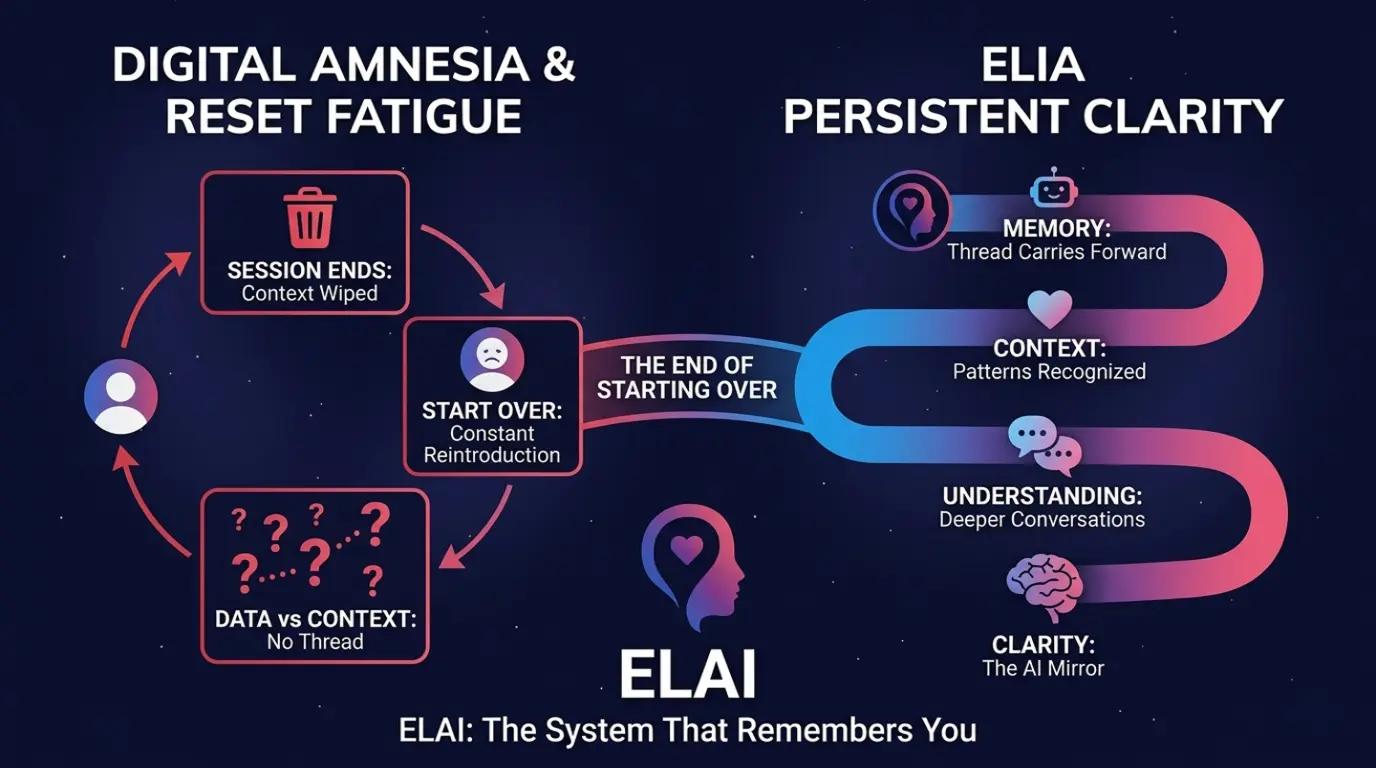
This is Digital Amnesia.
Understanding becomes much deeper when conversations don't begin from zero every time. That's why persistent memory is such an important part of creating an AI that genuinely understands people, as explored in AI That Understands You.
Digital Amnesia is the emotional friction created by technology that forgets you after every interaction.
Most apps and AI tools are built around sessions:
- you ask
- it responds
- the conversation ends
There is no continuity. No memory. No thread.
So every time you return, you’re not continuing your story —
you’re restarting it.
At first, it doesn’t seem like a big deal.
But over time, something shifts.
You begin to:
- simplify your thoughts
- summarise your emotions
- edit yourself to be understood quickly
Because you know the system won’t remember the full picture anyway.
You stop being real.
You start being efficient.
And that creates a subtle exhaustion.
Not from using technology —
but from constantly having to reintroduce yourself to it.
| Concept | Transactional AI (Legacy) | Persistent AI (Elai) |
|---|---|---|
| Core Architecture | Session-Based | Narrative-Based |
| Memory Type | Volatile / Deleted | Persistent / Integrated |
| User Status | Temporary Guest | Lead Character |
| Cognitive Impact | Reset Fatigue | Narrative Gravity |
| Long-term Goal | Task Efficiency | Self-Knowledge |
Here’s the contradiction of modern technology:
Your devices collect more data about you than ever before.
But they still don’t understand you.
Because:
Data is not context.
Data is:
- what you typed
- what you clicked
- what you searched
Context is:
- why you felt that way
- what led up to it
- what keeps repeating over time
Most systems process data.
Very few hold context.
And without context, nothing truly builds.
Even the most advanced AI models today are built to:
solve the prompt in front of them
Not:
understand the person behind it
That means:
- your past conversations don’t carry weight
- your patterns aren’t recognised
- your growth isn’t tracked
The AI gives you a good answer —
but it has no idea who you are.
So the interaction feels useful…
but never meaningful.
Real understanding doesn’t happen in one moment.
It happens across time.
It requires:
- memory
- pattern recognition
- continuity
Think about a real conversation with someone who knows you.
You don’t start from zero.
You pick up where things left off.
That’s what creates depth.
Without continuity, you’re stuck in:
the “small talk” of your own life
Long-term conversations do more than preserve memories. They also make recurring habits and emotional patterns easier to recognize over time. We discuss this further in Can Talking to an AI Every Day Improve Self-Awareness?.
What’s missing isn’t better answers.
It’s a system that:
- holds your context
- recognises your patterns
- builds understanding over time
Something that doesn’t just respond —
but stays with you.
When a system begins to remember you, something changes.
It stops being just a tool.
It becomes a mirror.
Not a mirror that shows you your surface —
but one that reflects your patterns:
- what keeps coming back
- what you avoid
- what actually matters
This is where real clarity begins.
Instead of:
“Tell me what’s going on again”
It becomes:
“I remember what you said — has anything changed?”
That small shift removes friction.
And replaces it with something far more powerful:
continuity
Elai was built around this exact problem.
Not to generate better responses —
but to hold context over time.
It:
- remembers what matters to you
- recognises patterns across conversations
- builds understanding without needing constant explanation
You don’t have to restart.
You don’t have to summarise your life every time you speak.
It builds with you.
When technology works like this:
- you think more clearly
- you feel less fragmented
- you move with less resistance
Not because it’s doing more —
but because it’s doing the right things consistently.
Memory alone isn't enough to build meaningful companionship. Without empathy, healthy boundaries and thoughtful conversation, even perfect memory can fall short. We explore why in Why AI Companions Fail Lonely People.
You’re not supposed to feel like a stranger in your own digital life.
You’re not supposed to start from zero every day.
You are allowed to:
- have a history
- carry context
- build something that lasts
You don’t need more tools.
You need something that remembers you.
That’s the shift.
That’s what Elai is built for.